
Best Ribbon for Wedding Bouquets: Satin, Organza or Silk?
Quick answer: For most wedding bouquets, 25mm (1-inch) double-sided satin ribbon is the most versatile default — it holds a crisp bow, comes in the widest color range, and costs significantly less than genuine silk. Choose organza when you want a sheer, airy layer without adding visual weight. Choose genuine silk when the bouquet will be photographed in motion or styled with loose, garden-style flowers, because silk’s advantage is its fluid drape, not its shine.
This guide is maintained by the RibbonBuy product team, based on wholesale ribbon orders and florist feedback across multiple wedding seasons. Last updated: .
Choosing the right ribbon for a wedding bouquet may seem like a small detail, but it changes the overall look of bridal flowers more than most people expect. The right ribbon adds color, texture and elegance while giving the bouquet stems a clean, finished handle.
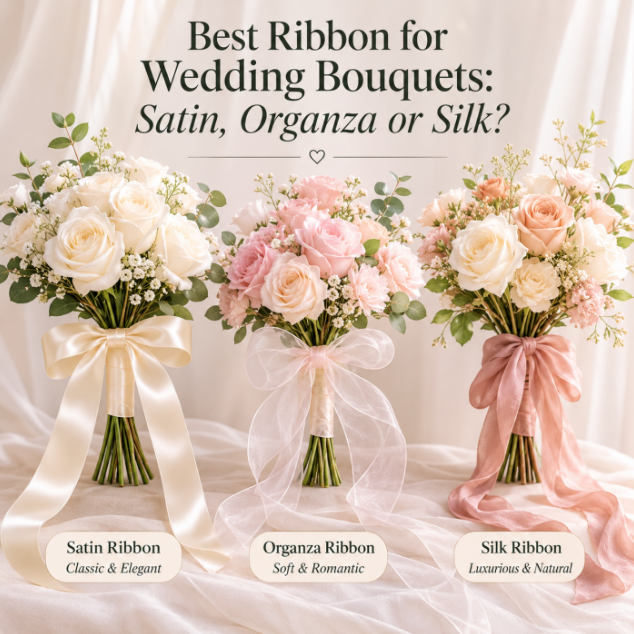
The three most common choices are satin, organza and silk. They look similar in a product photo and behave very differently in a real bouquet. This guide compares them on the things that actually matter — how they hold a bow, how they drape, how they handle heat and humidity, and how much ribbon you need — so you can choose with confidence rather than by guesswork.
1. Why the ribbon matters for a wedding bouquet
Bouquet ribbon is not just decoration. It does four practical jobs:
- It finishes the bouquet. A carefully chosen ribbon adds an elegant final touch to fresh flowers.
- It ties the wedding theme together. Matching ribbon to bridesmaid dresses, table linens or floral arrangements creates a coordinated look.
- It adds texture and movement. Flowing tails make a bouquet read as softer and more romantic in photos.
- It covers the mechanics. Ribbon wrapping hides floral tape and stems and gives the handle a neat, comfortable finish.
Whether you are planning a classic white wedding, a garden ceremony or a modern minimalist celebration, the ribbon is the last thing a guest’s eye lands on — and often the first thing a camera catches.
2. Satin vs organza vs silk: which ribbon is best for a wedding bouquet?
2.1 Satin ribbon — classic and elegant
Satin is a weave, not a fibre. Most wedding satin ribbon is woven from polyester, which is why it is affordable, color-fast and widely available. Its smooth, lightly reflective surface creates a refined look that suits both traditional and modern weddings.
Why choose satin ribbon?
- Smooth, glossy surface with a clean, elegant finish.
- Available in the widest range of colors and widths.
- Holds a defined bow shape without extra support.
- Wraps neatly around stems and stays flat.
- Suitable for classic, romantic and formal weddings.
Satin looks especially good with white roses, peonies, lilies and other classic bridal flowers. For a timeless look, consider ivory, white, champagne or blush pink satin — shades that complement many palettes without overpowering the flowers.
Our suggestion: double-sided satin ribbon is worth the small extra cost. In a bow, and especially in flowing tails, both faces of the ribbon are visible, and a single-sided ribbon will show its dull reverse side.
Best for: classic bridal bouquets, elegant ceremonies, traditional arrangements, and neatly wrapped bouquet handles.
2.2 Organza ribbon — soft and romantic
Organza is a lightweight, sheer fabric with a slightly crisp hand. Its transparency creates a soft decorative layer without making the bouquet look heavy.
Why choose organza ribbon?
- Lightweight and semi-transparent.
- Creates an airy, delicate appearance.
- Adds volume without overwhelming the flowers.
- Layers beautifully over satin.
- Suits romantic, garden and outdoor weddings.
Organza works particularly well with peonies, garden roses, hydrangeas and pastel arrangements. A common and effective technique is to wrap the handle in satin for structure, then add organza tails for softness.
One practical note: organza holds a bow less firmly than satin. If your design depends on a crisp, symmetrical bow, use satin as the structural ribbon and organza only as a decorative layer.
Best for: garden weddings, romantic bouquets, pastel arrangements, and layered ribbon decoration.
2.3 Silk ribbon — luxurious and naturally flowing
Genuine silk ribbon is made from natural silk fibres rather than polyester. It is valued for its soft texture and, above all, its fluid drape — the way the tails fall and move.
Why choose silk ribbon?
- Soft, naturally flowing texture.
- An elegant, organic appearance rather than a mirror shine.
- Creates relaxed, natural-looking tails.
- Pairs especially well with loose, garden-style bouquets.
- Often available in delicate, sophisticated colors.
Silk is popular in romantic and luxury styling. It suits loosely arranged flowers, seasonal blooms and asymmetrical bouquets, where a stiff ribbon would look out of place. Popular shades include dusty rose, champagne, ivory, sage green and muted beige.
Two honest caveats. Genuine silk generally costs noticeably more than polyester satin or organza, and it requires more careful handling — silk absorbs moisture, so it should be kept dry before the event and not stored in damp conditions.
Best for: luxury weddings, garden-style bouquets, natural arrangements, and long flowing tails.
Important distinction: silk is a fibre; satin is a weave. A “silk satin” ribbon combines both, while a standard satin ribbon is usually polyester. If genuine silk matters to your design, always check the fibre composition on the product listing rather than relying on the word “satin”.
3. Satin vs organza vs silk: comparison chart
The table below compares the characteristics that actually affect a finished bouquet.
| Feature | Satin ribbon (polyester) | Organza ribbon | Silk ribbon (genuine) |
|---|---|---|---|
| Surface finish | Glossy, even reflection | Sheer, softly diffused | Soft, layered lustre |
| Bow hold | High — crisp, defined bows | Low — needs support to hold shape | Medium-low — relaxed, natural bows |
| Drape and movement | Medium; tails stay fairly stiff | Light and airy, floats rather than falls | Fluid and flowing; the strongest drape |
| Transparency | Opaque | Transparent | Usually opaque, varies by weight |
| Behaviour in heat and humidity | Stable; may show fading with prolonged sun exposure | Good dimensional stability, especially high-twist synthetic organza | Absorbs moisture; needs dry storage before the event |
| Relative cost | Low to medium | Low to medium | Premium |
| Best wedding style | Classic, polished, formal | Romantic, airy, garden | Luxury, organic, editorial |
Which one should you choose?
- Choose satin for a classic, polished bouquet with a defined bow.
- Choose organza for a light, romantic, layered look.
- Choose silk for a luxurious bouquet with naturally falling tails.
There is no single best option for every wedding. The right choice depends on your flowers, theme, personal style and budget — and on which of those three is the priority.
4. How to choose the right ribbon width
Ribbon width affects a bouquet more than most brides expect. A narrow ribbon reads as delicate and understated; a wide ribbon becomes a design statement.
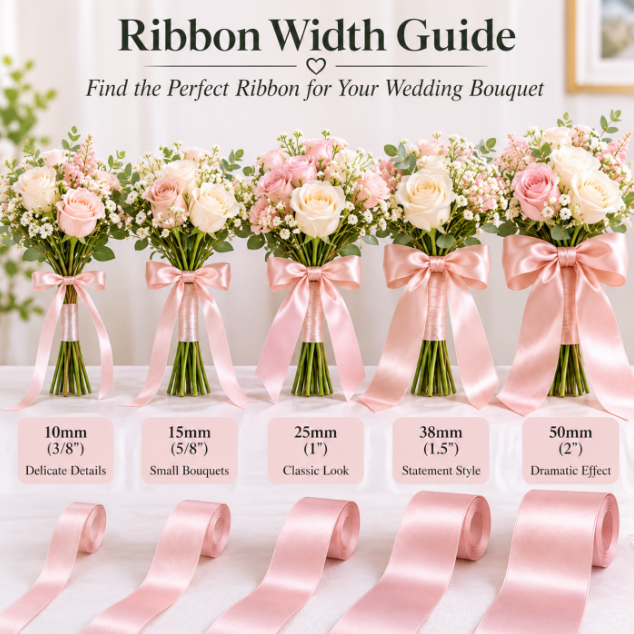
A useful rule of thumb: choose a ribbon width of roughly one-tenth of the bouquet’s diameter. A 25cm-wide bouquet pairs well with a 25mm ribbon; a 40cm bouquet suits a 38–40mm ribbon. The rule keeps the ribbon proportional to the flowers rather than competing with them.
| Ribbon width | Approx. inches | Recommended use |
|---|---|---|
| 10mm | 3/8 inch | Boutonnieres, place cards and fine detail work; too narrow for a main bridal bow |
| 15mm | 5/8 inch | Small bridal bouquets and bridesmaid bouquets |
| 25mm | 1 inch | The versatile default for most bridal bouquets |
| 38mm | 1.5 inches | Larger bouquets and statement bows |
| 50mm | 2 inches | Wide tails and dramatic decorative wrapping |
Tips for choosing width:
- Small bouquets generally look better with narrower ribbon.
- Medium bouquets work well with 25mm or 38mm.
- Large bouquets can carry wider ribbon and longer tails.
- For a dramatic flowing effect, go up one width rather than adding more ribbon.
These are styling guidelines, not rules. Experiment with a short length before committing to a full bouquet.
5. How to choose the ribbon color
Color coordination matters, but your ribbon does not need to match the flowers exactly. A complementary shade often produces a more beautiful result than an exact match.
Ivory and white
Timeless choices that pair with white roses, peonies and classic bridal arrangements.
Champagne and beige
Warm and sophisticated. Especially suited to neutral palettes and elegant indoor ceremonies.
Blush pink and dusty rose
Romantic and feminine. Work beautifully with pastel flowers, garden roses and spring arrangements.
Sage green
Excellent for natural and botanical themes. Complements greenery, white flowers and earthy palettes.
Dusty blue
Creates a subtle contrast with white and cream flowers. A strong option for outdoor and summer weddings.
Burgundy
Adds depth and richness. Particularly effective for autumn weddings and darker floral arrangements.
A practical tip: compare your final ribbon color with the actual flowers and wedding fabrics under natural daylight. Colors shift noticeably under indoor lighting and in photographs.
6. How much ribbon do you need?
The amount depends on bouquet size, wrapping method and whether you want decorative tails. Here are realistic starting points:
| Bouquet style | Suggested ribbon length |
|---|---|
| Handle wrapping only | 1–1.5 yards (approx. 1–1.4 m) |
| Handle wrapping with a small bow | 1.5–2 yards (approx. 1.4–1.8 m) |
| Wrapping with medium tails | 2–3 yards (approx. 1.8–2.7 m) |
| Long flowing tails | 3–5 yards (approx. 2.7–4.6 m) |
How that breaks down in practice: a large bridal bouquet using around 120cm of ribbon is typically made up of roughly 70cm for the statement bow, 30cm for the tails and 20cm for wrapping the handle. Breaking the total down this way makes it much easier to estimate for a custom design.
These are general estimates. Larger bouquets, wide ribbon, layered bows and extra-long tails will need more. If you are unsure, buy extra — running short mid-project is far more costly than a small amount of leftover ribbon.
7. How to wrap a wedding bouquet with ribbon
Wrapping a bouquet is easier than it looks. With a little preparation you can get a clean, professional finish without floral design experience.
What you’ll need:
- Your bouquet
- Satin or organza ribbon
- Floral tape
- Scissors
- Small pins or an equivalent fastening method
Step 1 — Tape the stems first, then trim to a uniform length
Arrange the flowers and secure the stems with floral tape before you touch the ribbon. Trim the stems to an even length so the handle is straight and comfortable to hold.
Step 2 — Anchor the ribbon at the top of the handle, not the middle
Position one end of the ribbon near the top of the handle and secure it with a pin or a small wrap of floral tape. Starting at the top prevents the ribbon from sliding down as you work, which is the most common cause of slipping.
Step 3 — Wrap with roughly 50% overlap and consistent tension
Work downward around the stems, overlapping each turn by about half the ribbon width. Keep the tension even — firm enough to stay in place, loose enough that the handle remains comfortable.
Step 4 — Finish with a knot before the bow
Secure the end with a simple knot at the base of the handle, then tie your bow on top of it. The knot carries the load; the bow is decorative. Relying on the bow alone is why ribbon comes loose during a ceremony.
Step 5 — Cut the tails at an angle or into a soft V
An angled or V-shaped cut reduces fraying and looks more intentional than a straight cut. For a romantic finish, let the tails fall naturally below the bouquet.
8. Where to buy ribbon for wedding bouquets
Choosing bouquet ribbon is about more than picking a color. Material quality, width, texture and suitability for your design all matter.
At RibbonBuy or SeekRibbon you can explore ribbon options for wedding flowers, bridal bouquets, gift packaging and DIY wedding decorations:
- Satin ribbon — a great option for classic and elegant bouquets, available in a range of widths and colors. See our double-sided satin ribbon collection.
- Organza ribbon — ideal for romantic arrangements, soft bows and delicate tails. Browse our organza ribbon collection.
Order a little extra for practice and last-minute adjustments, and check fibre composition on the product page if genuine silk is important to your design.
9. Frequently asked questions
What is the best ribbon for a bridal bouquet?
25mm double-sided satin is the best all-around ribbon for a bridal bouquet. It holds a defined bow, comes in the widest color range and costs far less than genuine silk. Choose organza only if you want a sheer decorative layer, and choose silk only if fluid drape is your priority.
Is satin or silk ribbon better for wedding bouquets?
Neither is objectively better — they solve different problems. Satin gives a polished, consistent look, holds a crisp bow and is generally more affordable. Silk has a softer, more natural drape and is preferred for luxury and garden-style bouquets. Satin is a weave; silk is a fibre, so check the composition if genuine silk matters.
What width ribbon is best for a wedding bouquet?
25mm (1 inch) is the most versatile width for a bridal bouquet. Use 10mm or 15mm for small arrangements and boutonnieres, and 38mm or 50mm for larger bouquets, statement bows and dramatic tails. A useful rule: ribbon width should be roughly one-tenth of the bouquet’s diameter.
How long should bouquet ribbon tails be?
There is no fixed rule, but most designs use tails between 6 and 18 inches. Short tails read as neat and classic; longer tails add movement and romance. Tails that reach more than a foot below the stems are common in loose, garden-style bouquets.
Can you use organza ribbon for wedding bouquets?
Yes — organza is a good choice for bouquets when used as a decorative layer. It is lightweight and semi-transparent, and works particularly well with pastel flowers, garden arrangements and romantic themes. Because it holds a bow less firmly than satin, it is usually layered over a satin wrap rather than used alone.
How do you keep ribbon from slipping off a bouquet?
Anchor the ribbon at the top of the handle before wrapping, and tie a knot at the base before adding the bow. Keep tension consistent as you wrap and finish with floral tape or a pin. A loose knot alone is the most common reason ribbon slips during a ceremony.
What color ribbon goes best with a white wedding dress?
Ivory, white, champagne, blush pink and dusty blue are the safest choices for a white dress. The best option depends on your flowers, bridesmaid dresses and overall color palette. Ivory and champagne tend to look richer than pure white against most bridal fabrics.
Does satin ribbon fade or damage flowers?
Satin ribbon does not damage flowers and is generally stable, though it can fade with prolonged direct sun exposure. Store ribbon away from strong light before the event, and keep genuine silk dry, as it absorbs moisture.
Final thoughts
The best ribbon for a wedding bouquet depends on the look you want to create. Satin is a timeless choice for elegant, polished arrangements. Organza adds softness and a romantic layer. Silk offers a luxurious, naturally flowing finish.
If you want one reliable answer: start with 25mm double-sided satin, then add organza or silk as a second layer if your design calls for it. That approach covers most bouquets and most budgets.
Explore RibbonBuy’s ribbon collections to find the colors, widths and textures for your next wedding project.
